


In the fields of high and low voltage switchgear manufacturing and electrical panel production, busbars (usually made of highly conductive copper or aluminum) serve as the core carrier for current transmission, and their processing accuracy and efficiency directly affect the safety and stability of the entire power system. Busbar bending machines are key equipment specifically designed for the precise L-shaped, U-shaped, Z-shaped, and other bending processes of busbars.
¿Qué es una máquina dobladora de barras colectoras?
A busbar bending machine is a mechanical device that uses hydraulic drive or servo control and is equipped with bending dies to bend copper or aluminum busbars into various shapes according to the design requirements of the drawings.
Common busbar bending processes
A fully functional busbar bending machine can perform various complex electrical wiring processes by changing the appropriate dies:
- Flat Bending: The most common bending method. The wide side of the busbar is parallel to the worktable surface and bent in the thickness direction (usually into a **90°** L-shape or Z-shape) to change the horizontal direction of the busbar.
- Vertical/Edge Bending: A highly complex process. The narrow side of the busbar is placed on the worktable and bent in the width direction. Due to the small force area and high deformation resistance on the side, it is very easy to cause wrinkling on the inside of the copper busbar or tearing on the outside. This requires the bending machine to have extremely high mechanical rigidity and specially designed movable edge bending dies.
- U-shaped Bending: Used for special electrical overlaps, achieved through a one-time forming U-shaped die or two consecutive flat bends.
- Twisting: Twist the busbar along its longitudinal axis by a certain angle (usually 90°). It is often used to change the connection plane of the busbar, for example, to twist the horizontal copper busbar to a vertical direction to connect to the circuit breaker.
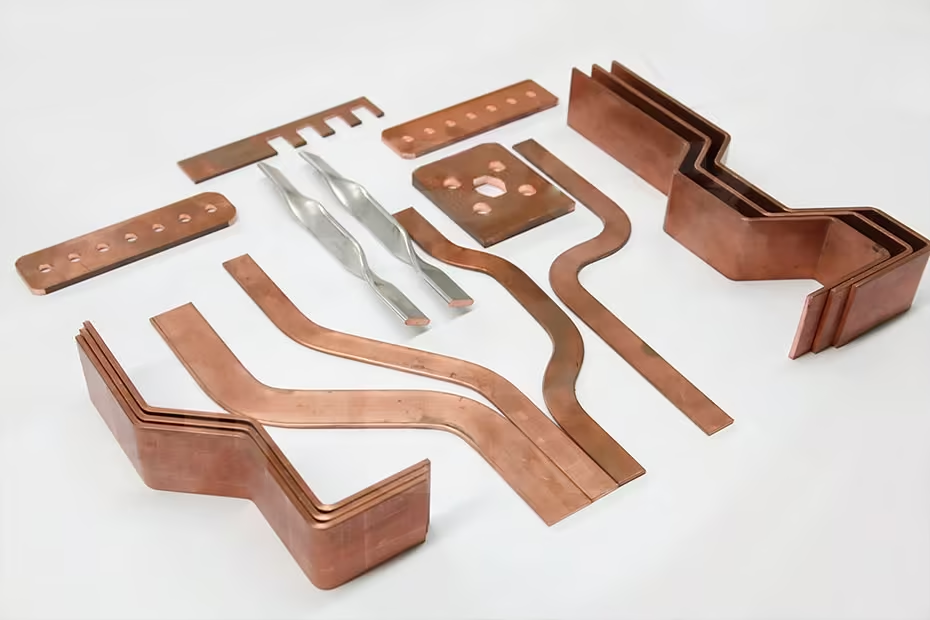
Images: Vertical bend, horizontal bend, twisted pattern
Types of busbar bending machines
Based on functional integration and control methods, busbar bending machines on the market are mainly divided into:
- CNC Busbar Bending Machine: Focused on a single bending process, with extremely high precision. Equipped with an automatic feeding system, the machine can automatically complete precise positioning and multi-pass continuous bending simply by importing CAD processing drawings. Suitable for mass production of single varieties.
- 3-in-1 Busbar Machine: Integrate punching, shearing, and bending stations. The three stations can usually work simultaneously without interference. This is currently the most widely used model in low-voltage switchgear factories because it solves all the core requirements of busbar processing in one machine.
- Portable Busbar Bending Machine: Small in size and lightweight, usually manual hydraulic or separate electro-hydraulic models. Mainly used for temporary repairs at power construction sites, high-altitude operations, or renovation projects in confined spaces. Highly mobile, but with relatively low processing efficiency.
Busbar bending working principle
The working principle of a busbar bending machine is primarily based on extrusion molding technology. Traditional busbar bending machines typically use a hydraulic station for power, with a high-pressure oil pump driving hydraulic cylinders for linear motion. Their output tonnage is usually between 30 and 80 tons. Modern high-end CNC busbar bending machines, however, employ fully electric servo systems, enabling more precise control of the pressing speed and micron-level stroke.
The machine’s actuators consist of an upper die (punch) and a lower die (concave die). During operation, the busbar is placed between the upper and lower dies. When the upper die is pushed downwards under strong pressure, the busbar undergoes plastic deformation according to the opening width and preset shape of the lower die.
Nota: When copper or aluminum busbars are bent under stress, a certain degree of “springback” occurs when the external force is removed. Overcoming springback is the core technological barrier of bending machines.
- Traditional busbar bending machines rely on the operator’s experience, manually offsetting springback by observing with a ruler and applying pressure at multiple angles.
- Máquinas dobladoras de barras colectoras CNC, on the other hand, incorporate complex material mechanics algorithms. The operator only needs to input the busbar’s material, width, thickness, and desired angle on the touchscreen. The system automatically calculates the springback compensation value and precisely controls the cylinder’s stopping position, achieving extremely high precision with an error within ±0.3°.
Artículos relacionados: The Influence of Bending Radius and Springback on the Bending Accuracy of Copper Busbars
How to choose a suitable busbar bending machine?
Before selecting a busbar bending machine, it is necessary to clarify the busbar processing requirements of the company’s project, such as the maximum thickness and width of the busbar, bending process, level of automation, and production scale. Secondly, the technical parameters and software operating system of the copper busbar bending machine are crucial, as these affect bending accuracy and processing efficiency. Finally, the brand and after-sales service of the busbar bending machine should be considered.
Confirm busbar processing requirements
- Maximum Processing Size: Specify the maximum thickness and width of the copper/aluminum busbars you need to process. For example, common specifications are 12mm x 160mm or 15mm x 200mm.
- Processing Type: Do you only need simple flat bends (L-shaped, Z-shaped)? Or do you need more complex vertical bends (side bends) or even twisted bends ? If a large number of vertical bends are involved, a bending machine model with a powerful clamping mechanism must be selected.
- Automation Level: Does it support drawing import and editing functions? Can it achieve IoT connectivity with equipment such as CNC busbar punching and shearing machines?
Assess bus production scale
Choose the appropriate busbar bending machine type based on the scale of busbar bending processing. Common mainstream models:
Cost-effective option: 3-in-1 busbar bending machine (Recommended: SS-50-3CNC busbar bending machine)
- Integrates three stations: punching, cutting, and bending. It has a small footprint, is multi-functional, and economical.
- Suitable for small to medium-sized switchgear factories with a wide variety of products but small batch sizes.
Precision option: CNC busbar bending machine (Recommended: NC.40ZB-1200 busbar bending machine)
- Uses a fully electric servo system, handling only busbar bending. Equipped with an automatic material stop device, the system has a built-in angle compensation mechanism (typically within ±0.3°).
- Suitable for transformer factories or export-grade switchgear manufacturing with extremely high precision requirements.
Efficiency option: Fully automatic busbar production line
- Feeding, punching, cutting, and bending are all fully automated, with robotic loading and unloading.
- Suitable for ultra-large-scale assembly line operations.
Considering technical parameters and software systems
When selecting and purchasing a busbar bending machine, it is recommended to focus on the following indicators during sample testing or when reviewing the specifications:
| Key Considerations | Technical Points | Why is this important? |
|---|---|---|
| Bending Force (tonns) | Typically 30T, 50T, or 80T | It determines the thickness of the busbars you can bend. A larger tonnage margin means a longer machine lifespan. |
| Angle Accuracy Control | Whether it has springback compensation function | Different batches of copper busbars have varying hardness; a CNC system with automatic compensation can significantly reduce the scrap rate. |
| Die (V-shaped) Configuration | Whether it provides lower dies with multiple opening widths | As mentioned in previous articles, V = (6~8) × t. A complete set of dies is necessary to handle different thicknesses. |
| Width-to-Thickness Ratio Support | Anti-wrinkle capability during vertical bending | For busbars with a width-to-thickness ratio greater than 10, ordinary machines will cause wrinkling during vertical bending; it's necessary to check for lateral pressure. |
For CNC busbar bending machine software usability directly impacts worker learning speed:
- Intuitive programming: Does it support direct input of target angles and dimensions?
- 3D simulation: High-end systems can preview bending effects to prevent mold collisions.
- Drawing import: Does it support direct conversion of CAD data into machining programs?
Brand reputation and after-sales service
After finalizing the equipment model, the following points are equally important:
- Core component brands: Hydraulic pumps, PLCs (such as Siemens/Delta), servo motors. Brand-name components mean spare parts are easier to find globally.
- After-sales service response: Can remote video guidance or overseas maintenance services be provided?
- Manufacturing process: Observe whether the welding of the machine body is solid and whether the wear on the guide rails has been hardened.
Pitfall Avoidance Guide
- Don’t just look at the tonnage: A 50-ton machine with insufficient rigidity will have its frame “open” during bending, resulting in inaccurate angles.
- Pay attention to heat dissipation: If continuous 24-hour operation is required, check if the hydraulic system has an air-cooled or water-cooled radiator; otherwise, excessive oil temperature will cause accuracy drift.
Recommended busbar bending machine manufacturers
When choosing a busbar bending machine manufacturer, you typically need to consider your budget, processing accuracy requirements, and after-sales service capabilities. Currently, the global market is mainly divided into high-end European brands (technology leaders) y Chinese brands (global leaders in cost-effectiveness and multi-functional integration).
European high-end brands
1. Boschert
Boschert is a pioneer in metalworking. Its busbar bending machines (such as the CU-Pro series) are renowned for their **extremely high mechanical rigidity** and **CNC precision**.
Features: Employs a unique quick-change die system, resulting in extremely stable bending accuracy, ideal for processing copper busbars with large aspect ratios.
2. Ehrt
Focuses on high-precision busbar bending solutions.
Features: Its equipment is highly intelligent, seamlessly integrating with CAD/CAM systems, offering a high degree of automation, supporting complex continuous bending tasks with minimal human intervention.
3. Alfra
Focuses on providing the most efficient tools for control panel manufacturing, switchgear production, and power distribution systems.
Features: Extremely robust machine body with minimal deformation under full-load bending, ensuring long-term processing accuracy. High emphasis is placed on operator comfort, and die changes are extremely simple and quick.
China's top manufacturer (with the highest global market share)
China (especially Jinan, Shandong) is the global manufacturing center for busbar processing machinery. These brands sell well worldwide due to their “3-in-1” functionality and excellent cost-performance ratio.
1. SUNSHINE
SUNSHINE is currently a leading Chinese brand of busbar machine exports, with its equipment holding a very high market share in Southeast Asia, the Middle East, Russia, and Latin America.
- Advantages:
- Multi-functional Integration: Its typical 3-in-1 model perfectly combines punching, shearing, and bending.
- Mature CNC System: It has a built-in, sophisticated bending springback compensation algorithm, and a simple and easy-to-understand user interface.
- After-sales Network: It has a well-established overseas agency and after-sales service system.
2. IMPERMEABLE
Focusing on high-precision CNC busbar bending machines and automated production lines.
- Advantages:
- Significant R&D investment in fully automatic feeding, large-tonnage bending, and complex bending processes makes it an ideal choice for companies seeking high production efficiency.
3. JPSK
A long-established manufacturer, known for its durable and robust equipment.
- Advantages:
- Its hydraulic systems and frame structures are designed for exceptional durability, making them suitable for high-intensity industrial environments.
| Brand Classification | Representative manufacturers | Core Advantages | Recommended Application Scenarios |
|---|---|---|---|
| High-end Precision | Boschert, Ehrt | Angle error < ±0.2°, highly digitalized | Export-grade precision cabinets, aerospace, ultra-high voltage equipment |
| High-efficiency Integrated | SUNSHINE, MAC, JPSK | Integrated punching, shearing and bending, extremely cost-effective, easy to operate | Medium and low voltage complete set manufacturers, distribution box production, general processing |
| Portable Construction Type | Alfra | Lightweight, suitable for on-site operations | Substation on-site maintenance, construction in confined spaces |
Purchase advice: How to evaluate these busbar bending machine manufacturers?
When communicating with these manufacturers, we suggest you focus on the following three points to ensure the equipment meets the previously mentioned “vertical bending” and “precision” requirements:
- Actual machine testing of the “width-to-thickness ratio” limit: Request the manufacturer to machine a copper busbar with a width-to-thickness ratio greater than 10 (e.g., 120 × 10 mm) on-site for a vertical bending test. Observe whether there are wrinkles on the inner side and whether there are tears on the outer side.
- CNC system autonomy: Inquire whether the system has an “automatic springback compensation function.” Some cheaper brands only have simple stroke control, while excellent brands have angle closed-loop feedback.
- Core component brands: Check the brands of their hydraulic valves (e.g., Bosch Rexroth), PLCs (e.g., Siemens/Delta), and guide rails. The global compatibility of these components determines the maintenance difficulty of the equipment 5 years later.
Artículos recomendados
 In the stamping process of busbars, the minimum hole spacing design between two adjacent holes is crucial. If the hole…
 Busbar bending machine is a copper and aluminum busbar processing equipment that uses hydraulic drive or servo control and is…
 When punching, cutting, and bending copper and aluminum busbars, to avoid obvious bright bands/shear bands or even burrs on the…
 The most detailed operating steps for copper busbars: punching, bending, and cutting.
 Busbar punching, cutting and bending machine, CNC busbar machine, maximum processing capacity of 12*160mm copper busbar, supports 3 people to…
 La mejor máquina de barras colectoras de cobre, con las funciones de punzonadora de barras colectoras y cortadora de barras colectoras, punzonadora de barras colectoras con control CNC, corte…
 Nos tomamos muy en serio la fabricación de barras colectoras de cobre, incluyendo el punzonado, corte y doblado. De hecho, podemos diseñar una solución a medida.
 La máquina punzonadora de barras colectoras SUNSHINE se ha convertido en el equipo de fabricación de barras colectoras preferido por los fabricantes de cuadros de distribución de alta y baja tensión y…
La Feria de Importación y Exportación de China recomienda la máquina de barras colectoras SUNSHINE®
ContáctenosObtenga la mejor cotización de máquinas de barras colectoras de SunShine® en China
¡Revisamos rápidamente sus requisitos y brindamos soluciones técnicas profesionales de manera eficiente! Escuchamos y nos preocupamos por sus necesidades. Nuestra gente se pondrá en contacto con usted por correo electrónico y llamadas telefónicas dentro de las 24 horas.
¿Dónde comprar una máquina de barras colectoras de calidad confiable?
Somos un fabricante y fábrica de máquinas de barras colectoras de China. Comuníquese con nuestra gerente de ventas Lisa (Correo electrónico: lisa@busbarmachine.co) y proporcionar planos de barras colectoras o muestras de productos. Evaluaremos y fabricaremos el mejor producto o producto recomendado para usted. Personalización de la máquina de barras colectoras (función o PLC) y cotización técnica completa proporcionada.
Con un presupuesto limitado, ¿qué modelo de máquina de barras colectoras comprar?
SUNSHINE cuenta con máquinas de barras colectoras económicas y máquinas de barras colectoras CNC automáticas de alto rendimiento, y puede personalizar los planes de cotización técnica de acuerdo con el sitio de producción del cliente, los requisitos de procesamiento de barras colectoras y el presupuesto de capital. Comuníquese con nuestra gerente de ventas profesional Lisa (Correo electrónico: lisa@busbarmachine.co) para soporte técnico y servicios de cotización.
Además de la máquina de barras colectoras, ¿proporcionan moldes de barras colectoras?
Generalmente regalamos algunos moldes de barras colectoras, que incluyen doblado, corte, punzonado y estampado, etc. Si tiene requisitos especiales de moldes de barras colectoras, podemos personalizarlos para usted, con precios que varían desde US$40 a US$100.
¿Cual es el voltaje de la máquina?
El voltaje estándar es trifásico, 220 V, 60 Hz. El voltaje se puede personalizar según los requisitos del cliente.
¿Cual es el plazo de entrega?
Esto depende de la disponibilidad de nuestro inventario y de la complejidad de la máquina de barras colectoras. Normalmente, se necesitan hasta 3 días si tenemos barras colectoras adecuadas en stock, y para las máquinas de barras colectoras que deben fabricarse de principio a fin, normalmente tardamos entre 7 y 15 días. Para máquinas complejas o líneas de producción de barras colectoras, necesitamos entre 20 y 30 días.
¿Cuál es su política de garantía?
Ofrecemos una garantía de 12 meses bajo un uso adecuado. Brindaremos asistencia remota y enviaremos piezas de repuesto gratuitas durante el período de garantía.
¿Cuales son sus condiciones de pago?
Nuestro plazo de pago es 30% pago por adelantado y 70% pago del saldo antes del envío.
¿Puede enviar ingenieros al extranjero para realizar servicios de instalación, capacitación o pruebas en el sitio?
Todas las máquinas se probarán y depurarán antes del envío. En principio, solo brindamos servicios de depuración y asistencia técnica remota. Si se trata de una línea de producción de barras colectoras, tendremos técnicos en el lugar para brindar servicio en el lugar.
¿Podemos visitar su fábrica o realizar una inspección en el sitio?
Damos la bienvenida a los clientes que quieran visitar e inspeccionar la fábrica. Comuníquese con nuestra gerente de ventas Lisa (Correo electrónico: lisa@busbarmachine.co) y cuéntanos tu agenda. Te enviaremos una carta de invitación comercial formal.
¿Puedo ser distribuidor de su fábrica en nuestro país?
Le damos la bienvenida a que solicite convertirse en nuestro distribuidor de máquinas de barras colectoras y desarrollar conjuntamente los mercados extranjeros. Le ofreceremos generosas comisiones de venta e incentivos adicionales en efectivo. Para obtener información sobre el contenido y los métodos de cooperación específicos, comuníquese con nuestro director ejecutivo Robin (Correo electrónico: ceo@busbarmachine.co).