


In the fields of high and low voltage switchgear manufacturing and electrical panel production, busbars (usually made of highly conductive copper or aluminum) serve as the core carrier for current transmission, and their processing accuracy and efficiency directly affect the safety and stability of the entire power system. Busbar bending machines are key equipment specifically designed for the precise L-shaped, U-shaped, Z-shaped, and other bending processes of busbars.
Что такое гибочный станок для шин?
A busbar bending machine is a mechanical device that uses hydraulic drive or servo control and is equipped with bending dies to bend copper or aluminum busbars into various shapes according to the design requirements of the drawings.
Common busbar bending processes
A fully functional busbar bending machine can perform various complex electrical wiring processes by changing the appropriate dies:
- Flat Bending: The most common bending method. The wide side of the busbar is parallel to the worktable surface and bent in the thickness direction (usually into a **90°** L-shape or Z-shape) to change the horizontal direction of the busbar.
- Vertical/Edge Bending: A highly complex process. The narrow side of the busbar is placed on the worktable and bent in the width direction. Due to the small force area and high deformation resistance on the side, it is very easy to cause wrinkling on the inside of the copper busbar or tearing on the outside. This requires the bending machine to have extremely high mechanical rigidity and specially designed movable edge bending dies.
- U-shaped Bending: Used for special electrical overlaps, achieved through a one-time forming U-shaped die or two consecutive flat bends.
- Twisting: Twist the busbar along its longitudinal axis by a certain angle (usually 90°). It is often used to change the connection plane of the busbar, for example, to twist the horizontal copper busbar to a vertical direction to connect to the circuit breaker.
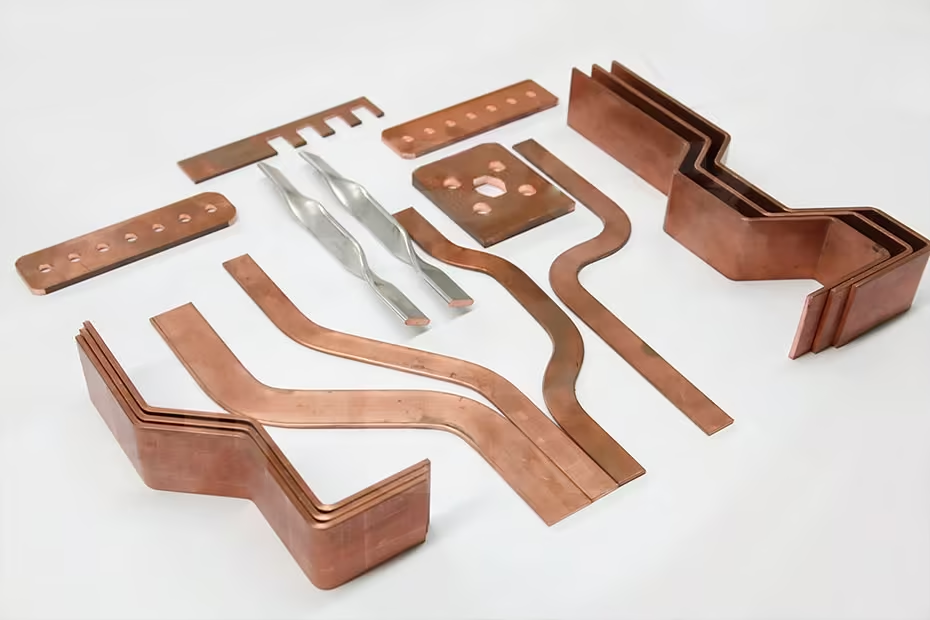
Images: Vertical bend, horizontal bend, twisted pattern
Types of busbar bending machines
Based on functional integration and control methods, busbar bending machines on the market are mainly divided into:
- CNC Busbar Bending Machine: Focused on a single bending process, with extremely high precision. Equipped with an automatic feeding system, the machine can automatically complete precise positioning and multi-pass continuous bending simply by importing CAD processing drawings. Suitable for mass production of single varieties.
- 3-in-1 Busbar Machine: Integrate punching, shearing, and bending stations. The three stations can usually work simultaneously without interference. This is currently the most widely used model in low-voltage switchgear factories because it solves all the core requirements of busbar processing in one machine.
- Portable Busbar Bending Machine: Small in size and lightweight, usually manual hydraulic or separate electro-hydraulic models. Mainly used for temporary repairs at power construction sites, high-altitude operations, or renovation projects in confined spaces. Highly mobile, but with relatively low processing efficiency.
Busbar bending working principle
The working principle of a busbar bending machine is primarily based on extrusion molding technology. Traditional busbar bending machines typically use a hydraulic station for power, with a high-pressure oil pump driving hydraulic cylinders for linear motion. Their output tonnage is usually between 30 and 80 tons. Modern high-end CNC busbar bending machines, however, employ fully electric servo systems, enabling more precise control of the pressing speed and micron-level stroke.
The machine’s actuators consist of an upper die (punch) and a lower die (concave die). During operation, the busbar is placed between the upper and lower dies. When the upper die is pushed downwards under strong pressure, the busbar undergoes plastic deformation according to the opening width and preset shape of the lower die.
Примечание: When copper or aluminum busbars are bent under stress, a certain degree of “springback” occurs when the external force is removed. Overcoming springback is the core technological barrier of bending machines.
- Traditional busbar bending machines rely on the operator’s experience, manually offsetting springback by observing with a ruler and applying pressure at multiple angles.
- Станки для гибки шин с ЧПУ, on the other hand, incorporate complex material mechanics algorithms. The operator only needs to input the busbar’s material, width, thickness, and desired angle on the touchscreen. The system automatically calculates the springback compensation value and precisely controls the cylinder’s stopping position, achieving extremely high precision with an error within ±0.3°.
Похожие статьи: The Influence of Bending Radius and Springback on the Bending Accuracy of Copper Busbars
How to choose a suitable busbar bending machine?
Before selecting a busbar bending machine, it is necessary to clarify the busbar processing requirements of the company’s project, such as the maximum thickness and width of the busbar, bending process, level of automation, and production scale. Secondly, the technical parameters and software operating system of the copper busbar bending machine are crucial, as these affect bending accuracy and processing efficiency. Finally, the brand and after-sales service of the busbar bending machine should be considered.
Confirm busbar processing requirements
- Maximum Processing Size: Specify the maximum thickness and width of the copper/aluminum busbars you need to process. For example, common specifications are 12mm x 160mm or 15mm x 200mm.
- Processing Type: Do you only need simple flat bends (L-shaped, Z-shaped)? Or do you need more complex vertical bends (side bends) or even twisted bends ? If a large number of vertical bends are involved, a bending machine model with a powerful clamping mechanism must be selected.
- Automation Level: Does it support drawing import and editing functions? Can it achieve IoT connectivity with equipment such as CNC busbar punching and shearing machines?
Assess bus production scale
Choose the appropriate busbar bending machine type based on the scale of busbar bending processing. Common mainstream models:
Cost-effective option: 3-in-1 busbar bending machine (Recommended: SS-50-3CNC busbar bending machine)
- Integrates three stations: punching, cutting, and bending. It has a small footprint, is multi-functional, and economical.
- Suitable for small to medium-sized switchgear factories with a wide variety of products but small batch sizes.
Precision option: CNC busbar bending machine (Recommended: NC.40ZB-1200 busbar bending machine)
- Uses a fully electric servo system, handling only busbar bending. Equipped with an automatic material stop device, the system has a built-in angle compensation mechanism (typically within ±0.3°).
- Suitable for transformer factories or export-grade switchgear manufacturing with extremely high precision requirements.
Efficiency option: Fully automatic busbar production line
- Feeding, punching, cutting, and bending are all fully automated, with robotic loading and unloading.
- Suitable for ultra-large-scale assembly line operations.
Considering technical parameters and software systems
When selecting and purchasing a busbar bending machine, it is recommended to focus on the following indicators during sample testing or when reviewing the specifications:
| Key Considerations | Technical Points | Why is this important? |
|---|---|---|
| Bending Force (tonns) | Typically 30T, 50T, or 80T | It determines the thickness of the busbars you can bend. A larger tonnage margin means a longer machine lifespan. |
| Angle Accuracy Control | Whether it has springback compensation function | Different batches of copper busbars have varying hardness; a CNC system with automatic compensation can significantly reduce the scrap rate. |
| Die (V-shaped) Configuration | Whether it provides lower dies with multiple opening widths | As mentioned in previous articles, V = (6~8) × t. A complete set of dies is necessary to handle different thicknesses. |
| Width-to-Thickness Ratio Support | Anti-wrinkle capability during vertical bending | For busbars with a width-to-thickness ratio greater than 10, ordinary machines will cause wrinkling during vertical bending; it's necessary to check for lateral pressure. |
For CNC busbar bending machine software usability directly impacts worker learning speed:
- Intuitive programming: Does it support direct input of target angles and dimensions?
- 3D simulation: High-end systems can preview bending effects to prevent mold collisions.
- Drawing import: Does it support direct conversion of CAD data into machining programs?
Brand reputation and after-sales service
After finalizing the equipment model, the following points are equally important:
- Core component brands: Hydraulic pumps, PLCs (such as Siemens/Delta), servo motors. Brand-name components mean spare parts are easier to find globally.
- After-sales service response: Can remote video guidance or overseas maintenance services be provided?
- Manufacturing process: Observe whether the welding of the machine body is solid and whether the wear on the guide rails has been hardened.
Pitfall Avoidance Guide
- Don’t just look at the tonnage: A 50-ton machine with insufficient rigidity will have its frame “open” during bending, resulting in inaccurate angles.
- Pay attention to heat dissipation: If continuous 24-hour operation is required, check if the hydraulic system has an air-cooled or water-cooled radiator; otherwise, excessive oil temperature will cause accuracy drift.
Recommended busbar bending machine manufacturers
When choosing a busbar bending machine manufacturer, you typically need to consider your budget, processing accuracy requirements, and after-sales service capabilities. Currently, the global market is mainly divided into high-end European brands (technology leaders) и Chinese brands (global leaders in cost-effectiveness and multi-functional integration).
European high-end brands
1. Boschert
Boschert is a pioneer in metalworking. Its busbar bending machines (such as the CU-Pro series) are renowned for their **extremely high mechanical rigidity** and **CNC precision**.
Features: Employs a unique quick-change die system, resulting in extremely stable bending accuracy, ideal for processing copper busbars with large aspect ratios.
2. Ehrt
Focuses on high-precision busbar bending solutions.
Features: Its equipment is highly intelligent, seamlessly integrating with CAD/CAM systems, offering a high degree of automation, supporting complex continuous bending tasks with minimal human intervention.
3. Alfra
Focuses on providing the most efficient tools for control panel manufacturing, switchgear production, and power distribution systems.
Features: Extremely robust machine body with minimal deformation under full-load bending, ensuring long-term processing accuracy. High emphasis is placed on operator comfort, and die changes are extremely simple and quick.
China's top manufacturer (with the highest global market share)
China (especially Jinan, Shandong) is the global manufacturing center for busbar processing machinery. These brands sell well worldwide due to their “3-in-1” functionality and excellent cost-performance ratio.
1. SUNSHINE
SUNSHINE is currently a leading Chinese brand of busbar machine exports, with its equipment holding a very high market share in Southeast Asia, the Middle East, Russia, and Latin America.
- Advantages:
- Multi-functional Integration: Its typical 3-in-1 model perfectly combines punching, shearing, and bending.
- Mature CNC System: It has a built-in, sophisticated bending springback compensation algorithm, and a simple and easy-to-understand user interface.
- After-sales Network: It has a well-established overseas agency and after-sales service system.
2. МАК
Focusing on high-precision CNC busbar bending machines and automated production lines.
- Advantages:
- Significant R&D investment in fully automatic feeding, large-tonnage bending, and complex bending processes makes it an ideal choice for companies seeking high production efficiency.
3. JPSK
A long-established manufacturer, known for its durable and robust equipment.
- Advantages:
- Its hydraulic systems and frame structures are designed for exceptional durability, making them suitable for high-intensity industrial environments.
| Brand Classification | Representative manufacturers | Core Advantages | Recommended Application Scenarios |
|---|---|---|---|
| High-end Precision | Boschert, Ehrt | Angle error < ±0.2°, highly digitalized | Export-grade precision cabinets, aerospace, ultra-high voltage equipment |
| High-efficiency Integrated | SUNSHINE, MAC, JPSK | Integrated punching, shearing and bending, extremely cost-effective, easy to operate | Medium and low voltage complete set manufacturers, distribution box production, general processing |
| Portable Construction Type | Alfra | Lightweight, suitable for on-site operations | Substation on-site maintenance, construction in confined spaces |
Purchase advice: How to evaluate these busbar bending machine manufacturers?
When communicating with these manufacturers, we suggest you focus on the following three points to ensure the equipment meets the previously mentioned “vertical bending” and “precision” requirements:
- Actual machine testing of the “width-to-thickness ratio” limit: Request the manufacturer to machine a copper busbar with a width-to-thickness ratio greater than 10 (e.g., 120 × 10 mm) on-site for a vertical bending test. Observe whether there are wrinkles on the inner side and whether there are tears on the outer side.
- CNC system autonomy: Inquire whether the system has an “automatic springback compensation function.” Some cheaper brands only have simple stroke control, while excellent brands have angle closed-loop feedback.
- Core component brands: Check the brands of their hydraulic valves (e.g., Bosch Rexroth), PLCs (e.g., Siemens/Delta), and guide rails. The global compatibility of these components determines the maintenance difficulty of the equipment 5 years later.
Рекомендованные статьи
 Busbar bending machine is a copper and aluminum busbar processing equipment that uses hydraulic drive or servo control and is…
 When punching, cutting, and bending copper and aluminum busbars, to avoid obvious bright bands/shear bands or even burrs on the…
 The most detailed operating steps for copper busbars: punching, bending, and cutting.
 Busbar punching, cutting and bending machine, CNC busbar machine, maximum processing capacity of 12*160mm copper busbar, supports 3 people to…
 Лучший станок для изготовления медных шин, с функциями станка для пробивки шин и станка для резки шин, пробивка шин с ЧПУ, резка…
 Мы серьезно относимся к изготовлению медных шин, включая пробивку, резку и гибку шин. Фактически, мы можем разработать индивидуальное решение…
 Машина для пробивки шин SUNSHINE стала предпочтительным оборудованием для изготовления шин для производителей высоковольтных и низковольтных распределительных устройств и электротехнических…
 Для крупных производителей шин, которым требуется высокая степень автоматизации и высокая эффективность производства при обработке шин, MAC MX602K-8C…
Китайская ярмарка импорта и экспорта рекомендует машину для производства шин SUNSHINE®
Связаться с намиПолучите лучшее предложение на шинопроводную машину от SunShine® в Китае
Быстро рассмотрим ваши требования и эффективно предоставим профессиональные технические решения! Мы прислушиваемся к вашим потребностям и заботимся о них. Наши сотрудники свяжутся с вами по электронной почте и по телефону в течение 24 часов.
Где купить надежный и качественный шинопровод?
Мы являемся производителем и фабрикой шинопроводных машин в Китае. Пожалуйста, свяжитесь с нашим менеджером по продажам Лизой (Электронная почта: lisa@busbarmachine.co) и предоставить чертежи шинопровода или образцы продукции. Мы оценим и сделаем для вас наилучший рекомендуемый продукт или продукт. Предоставлена настройка шинопровода (функция или ПЛК) и полное техническое предложение.
Какую модель шиномонтажного станка купить при ограниченном бюджете?
SUNSHINE имеет экономичные машины для шинопроводов и высокопроизводительные автоматические машины для шинопроводов с ЧПУ, а также может настраивать технические планы расценок в соответствии с производственной площадкой заказчика, требованиями к обработке шинопроводов и капитальным бюджетом. Пожалуйста, свяжитесь с нашим профессиональным менеджером по продажам Лизой (Электронная почта: lisa@busbarmachine.co) для технической поддержки и услуг по составлению расценок.
Помимо машины для производства шин, вы поставляете пресс-формы для шин?
Обычно мы отдаем некоторые формы для шинопроводов, включая формы для гибки, резки, штамповки, тиснения и т. д. Если у вас есть особые требования к формам для шинопроводов, мы можем изготовить их для вас по индивидуальным размерам, цены варьируются от US$40 до US$100.
Каково напряжение машины?
Стандартное напряжение - 3 фазы, 220 В, 60 Гц. Напряжение может быть настроено в соответствии с требованиями заказчика.
Каковы сроки выполнения заказа?
Это зависит от наличия на складе и сложности машины для шинопроводов. Обычно это занимает до 3 дней, если у нас есть подходящие шины на складе, а для машин для шинопроводов, которые необходимо изготовить от начала до конца, нам обычно требуется около 7–15 дней. Для сложных машин или линий по производству шин нам требуется около 20–30 дней.
Какова ваша гарантийная политика?
Мы предоставляем 12-месячную гарантию при условии надлежащего использования. Окажем удаленную помощь и отправим бесплатные запасные части в течение гарантийного срока.
Каковы ваши условия оплаты?
Наши условия оплаты: авансовый платеж 30% и оставшийся платеж 70% перед отгрузкой.
Можете ли вы направить инженеров за границу для выполнения услуг по установке, обучению или тестированию на месте?
Все машины будут проверены и отлажены перед отправкой. В принципе, мы предоставляем только удаленные услуги по отладке и удаленную техническую помощь. Если это линия по производству шин, у нас будут техники на месте для обслуживания на месте.
Можем ли мы посетить ваш завод или провести инспекцию на месте?
Мы очень приветствуем клиентов, желающих посетить и осмотреть фабрику. Пожалуйста, свяжитесь с нашим менеджером по продажам Лизой (Электронная почта: lisa@busbarmachine.co) и сообщите нам свое расписание. Мы вышлем вам официальное деловое приглашение.
Могу ли я стать дистрибьютором вашего завода в нашей стране?
Мы очень приветствуем вас, чтобы вы подали заявку на то, чтобы стать нашим дистрибьютором шинопроводных машин и совместно развивать зарубежные рынки. Мы предоставим щедрые комиссионные с продаж и дополнительные денежные поощрения. Для получения информации о конкретном содержании и методах сотрудничества, пожалуйста, свяжитесь с нашим генеральным директором Робином (Электронная почта: ceo@busbarmachine.co).