
Máy uốn thanh cái là gì?
When punching, cutting, and bending copper and aluminum busbars, to avoid obvious bright bands/shear bands or even burrs on the processed cross-section, it is recommended to establish two independent parameter libraries (“Copper-Lib” and “Aluminum-Lib”) in the CNC system of the busbar machine, and to distinguish between copper busbar-specific molds and aluminum busbar-specific molds for the…

In the fields of high and low voltage switchgear manufacturing and electrical panel production, busbars (usually made of highly conductive copper or aluminum) serve as the core carrier for current transmission, and their processing accuracy and efficiency directly affect the safety and stability of the entire power system. Busbar bending machines are key equipment specifically designed for the precise L-shaped, U-shaped, Z-shaped, and other bending processes of busbars.
Máy uốn thanh cái là gì?
A busbar bending machine is a mechanical device that uses hydraulic drive or servo control and is equipped with bending dies to bend copper or aluminum busbars into various shapes according to the design requirements of the drawings.
Common busbar bending processes
A fully functional busbar bending machine can perform various complex electrical wiring processes by changing the appropriate dies:
- Flat Bending: The most common bending method. The wide side of the busbar is parallel to the worktable surface and bent in the thickness direction (usually into a **90°** L-shape or Z-shape) to change the horizontal direction of the busbar.
- Vertical/Edge Bending: A highly complex process. The narrow side of the busbar is placed on the worktable and bent in the width direction. Due to the small force area and high deformation resistance on the side, it is very easy to cause wrinkling on the inside of the copper busbar or tearing on the outside. This requires the bending machine to have extremely high mechanical rigidity and specially designed movable edge bending dies.
- U-shaped Bending: Used for special electrical overlaps, achieved through a one-time forming U-shaped die or two consecutive flat bends.
- Twisting: Twist the busbar along its longitudinal axis by a certain angle (usually 90°). It is often used to change the connection plane of the busbar, for example, to twist the horizontal copper busbar to a vertical direction to connect to the circuit breaker.
Types of busbar bending machines
Based on functional integration and control methods, busbar bending machines on the market are mainly divided into:
- CNC Busbar Bending Machine: Focused on a single bending process, with extremely high precision. Equipped with an automatic feeding system, the machine can automatically complete precise positioning and multi-pass continuous bending simply by importing CAD processing drawings. Suitable for mass production of single varieties.
- 3-in-1 Busbar Machine: Integrate punching, shearing, and bending stations. The three stations can usually work simultaneously without interference. This is currently the most widely used model in low-voltage switchgear factories because it solves all the core requirements of busbar processing in one machine.
- Portable Busbar Bending Machine: Small in size and lightweight, usually manual hydraulic or separate electro-hydraulic models. Mainly used for temporary repairs at power construction sites, high-altitude operations, or renovation projects in confined spaces. Highly mobile, but with relatively low processing efficiency.
Busbar bending working principle
The working principle of a busbar bending machine is primarily based on extrusion molding technology. Traditional busbar bending machines typically use a hydraulic station for power, with a high-pressure oil pump driving hydraulic cylinders for linear motion. Their output tonnage is usually between 30 and 80 tons. Modern high-end CNC busbar bending machines, however, employ fully electric servo systems, enabling more precise control of the pressing speed and micron-level stroke.
The machine’s actuators consist of an upper die (punch) and a lower die (concave die). During operation, the busbar is placed between the upper and lower dies. When the upper die is pushed downwards under strong pressure, the busbar undergoes plastic deformation according to the opening width and preset shape of the lower die.
Ghi chú: When copper or aluminum busbars are bent under stress, a certain degree of “springback” occurs when the external force is removed. Overcoming springback is the core technological barrier of bending machines.
- Traditional busbar bending machines rely on the operator’s experience, manually offsetting springback by observing with a ruler and applying pressure at multiple angles.
- Máy uốn thanh cái CNC, on the other hand, incorporate complex material mechanics algorithms. The operator only needs to input the busbar’s material, width, thickness, and desired angle on the touchscreen. The system automatically calculates the springback compensation value and precisely controls the cylinder’s stopping position, achieving extremely high precision with an error within ±0.3°.
How to choose a suitable busbar bending machine?
Before selecting a busbar bending machine, it is necessary to clarify the busbar processing requirements of the company’s project, such as the maximum thickness and width of the busbar, bending process, level of automation, and production scale. Secondly, the technical parameters and software operating system of the copper busbar bending machine are crucial, as these affect bending accuracy and processing efficiency. Finally, the brand and after-sales service of the busbar bending machine should be considered.
| Tính năng | Copper busbar | Aluminum busbar | Processing impact |
|---|---|---|---|
| Hardness | Higher | Lower (Softer) | Copper requires greater shearing and punching pressure; aluminum tends to stick to the tool. |
| Ductility | Excellent | Good, but Brittle and easily broken | Copper can be bent with a small radius angle; aluminum is prone to cracking under small radius angles. |
| Rebound Rate | Smaller, more stable | Large and unstable | The bending angle compensation for aluminum needs to be set to a larger value. |
| Surface | Average scratch resistance | Very easy to scratch | Aluminum busbars require extra care during feeding and processing. |
Differences and precautions in punching unit processing
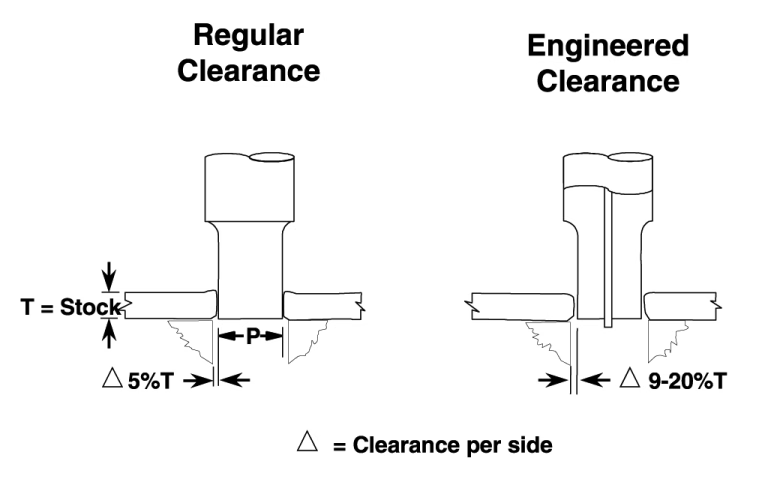
When punching copper busbars, the cut surface is usually clean with few burrs. However, due to the hardness of copper, the punching die head wears relatively quickly, requiring regular checks of the punch’s sharpness.
When punching aluminum busbars, the soft and sticky nature of aluminum makes it prone to **Galling**, where aluminum shavings adhere to the punch or die. Therefore, the die must be cleaned more frequently to prevent shavings buildup that could cause punching deformation or die jamming. For aluminum busbars, the die clearance can be appropriately reduced to ensure a smooth hole wall.
Differences and precautions in cutting unit processing
Copper busbars have high shear resistance and typically have a bright cross-section. However, one crucial point must be noted: ensure the shear blade is sharp. If the blade is dull, the copper busbar cross-section is prone to chipped corners or severe burrs.
Aluminum busbars, on the other hand, have low shear resistance but are easily deformed (flattened). During shearing, the pressure of the clamping foot (pressing device) must be moderate. Excessive pressure may leave indentations on the aluminum busbar surface, while insufficient pressure will result in a non-perpendicular cross-section.
Differences and Precautions in Bending Unit Processing – The Most Critical Step
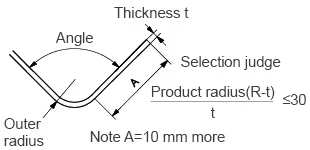
This is the process with the biggest difference between the two, mainly in the **bending radius (R angle) and springback compensation**.
Copper busbars have good ductility and can usually use smaller R angle dies (e.g., R = busbar thickness), making them less prone to cracking. Their springback angle is smaller (usually around 3°-5°), making CNC control easier.
Aluminum busbars (especially hard aluminum) are extremely prone to cracking when stretched on the outside. This requires that **larger bending R angle dies must be used when processing aluminum busbars**, and **it is generally recommended that the R angle be ≥ 1.5 to 2 times the aluminum busbar thickness**. The springback rate of aluminum is also usually greater than that of copper (depending on the aluminum grade), and there is significant batch-to-batch variation. If the target angle is 90°, copper may only need to be bent to 92°, while aluminum may need to be bent to 95° or even more to spring back to 90°. It is recommended to set up a separate material library parameter for aluminum busbars in the CNC system.
Operation and maintenance precautions
- **Mold Protection (Recommended)**
- Although copper and aluminum can use the same set of molds, to prevent **electrochemical corrosion** (copper-aluminum contact accelerates corrosion in humid environments), it is recommended to use separate molds for copper and aluminum whenever possible. If mixing is unavoidable, thoroughly clean any metal shavings from the molds before switching materials.
- **Surface Protection:**
- Aluminum busbars are very easily scratched. When dragging aluminum busbars for positioning, avoid dragging them hard on the worktable. It is recommended to apply anti-abrasion rubber pads to the worktable of the busbar machine or use an auxiliary bracket with rollers.
- **Lubrication:**
- When punching holes in aluminum busbars, apply a small amount of special lubricating oil or alcohol to the punch to reduce adhesion and improve demolding smoothness.
Summary and Recommendations
If you are conducting mass production, it is recommended to establish two independent parameter libraries (“Copper-Lib” and “Aluminum-Lib”) in the CNC system of the busbar machine, and to distinguish between copper busbar-specific dies and aluminum busbar-specific dies for the punching unit. It is crucial to record the different bending elastic coefficients and die radius selections for both. This way, when switching materials, you can simply call up the relevant parameters with one click, eliminating the need for repeated die trials.
Bài viết được đề xuất
 When punching, cutting, and bending copper and aluminum busbars, to avoid obvious bright bands/shear bands or even burrs on the…
- When punching, cutting, and bending copper and aluminum busbars, to avoid obvious bright bands/shear bands or even burrs on the…
 The most detailed operating steps for copper busbars: punching, bending, and cutting.
 Busbar punching, cutting and bending machine, CNC busbar machine, maximum processing capacity of 12*160mm copper busbar, supports 3 people to…
 Máy thanh cái đồng tốt nhất, có chức năng là máy đột thanh cái và máy cắt thanh cái, máy đột thanh cái điều khiển CNC, cắt…
 Chúng tôi coi trọng việc chế tạo thanh đồng, bao gồm đục, cắt và uốn thanh đồng. Trên thực tế, chúng tôi có thể thiết kế một giải pháp tùy chỉnh…
 Máy đột thanh cái SUNSHINE đã trở thành thiết bị chế tạo thanh cái được ưa chuộng cho các nhà sản xuất thiết bị đóng cắt điện áp cao và thấp cũng như các nhà điện…
 Đối với các nhà sản xuất thanh cái quy mô lớn đòi hỏi mức độ tự động hóa cao và hiệu quả sản xuất cao trong quá trình xử lý thanh cái, MAC MX602K-8C…
Hội chợ xuất nhập khẩu Trung Quốc giới thiệu máy thanh cái SUNSHINE®
Liên hệ với chúng tôiNhận báo giá máy thanh cái tốt nhất từ SunShine® tại Trung Quốc
Nhanh chóng xem xét yêu cầu của bạn và cung cấp các giải pháp kỹ thuật chuyên nghiệp một cách hiệu quả! Chúng tôi lắng nghe và quan tâm đến nhu cầu của bạn, Nhân viên của chúng tôi sẽ liên lạc với bạn qua email và điện thoại trong vòng 24 giờ.
Mua máy thanh cái chất lượng đáng tin cậy ở đâu?
Chúng tôi là nhà sản xuất và nhà máy máy thanh cái Trung Quốc. Vui lòng liên hệ với giám đốc bán hàng của chúng tôi Lisa (Email: lisa@busbarmachine.co) và cung cấp bản vẽ thanh cái hoặc mẫu sản phẩm. Chúng tôi sẽ đánh giá và tạo ra sản phẩm hoặc sản phẩm được đề xuất tốt nhất cho bạn. Tùy chỉnh máy thanh cái (chức năng hoặc PLC) và cung cấp báo giá kỹ thuật đầy đủ.
Với ngân sách hạn hẹp, nên mua máy thanh cái model nào?
SUNSHINE có máy thanh cái tiết kiệm và máy thanh cái CNC tự động hiệu suất cao, có thể tùy chỉnh các kế hoạch báo giá kỹ thuật theo địa điểm sản xuất của khách hàng, yêu cầu gia công thanh cái và ngân sách vốn. Vui lòng liên hệ với giám đốc bán hàng chuyên nghiệp của chúng tôi Lisa (Email: lisa@busbarmachine.co) để được hỗ trợ kỹ thuật và báo giá.
Ngoài máy thanh cái, bạn có cung cấp khuôn thanh cái không?
Chúng tôi thường tặng một số khuôn thanh cái, bao gồm uốn, cắt, đục lỗ và dập nổi, v.v. Nếu bạn có yêu cầu đặc biệt về khuôn thanh cái, chúng tôi có thể tùy chỉnh chúng cho bạn, với mức giá từ US$40 đến US$100.
Điện áp của máy là bao nhiêu?
Điện áp tiêu chuẩn là 3 pha, 220 V, 60 Hz. Điện áp có thể được tùy chỉnh theo yêu cầu của khách hàng.
Thời gian giao hàng là bao lâu?
Điều này phụ thuộc vào tình trạng hàng tồn kho và độ phức tạp của máy thanh cái. Thông thường, phải mất đến 3 ngày nếu chúng tôi có thanh cái phù hợp trong kho, và đối với máy thanh cái cần được sản xuất từ đầu đến cuối, chúng tôi thường mất khoảng 7 đến 15 ngày. Đối với máy móc phức tạp hoặc dây chuyền sản xuất thanh cái, chúng tôi cần khoảng 20 đến 30 ngày.
Chính sách bảo hành của bạn là gì?
Chúng tôi cung cấp bảo hành 12 tháng trong điều kiện sử dụng đúng cách. Sẽ cung cấp hỗ trợ từ xa và gửi các bộ phận thay thế miễn phí trong thời gian bảo hành.
Điều khoản thanh toán của bạn là gì?
Điều khoản thanh toán của chúng tôi là thanh toán trước 30% và thanh toán số dư 70% trước khi giao hàng.
Bạn có thể cử kỹ sư ra nước ngoài để thực hiện dịch vụ lắp đặt, đào tạo hoặc thử nghiệm tại chỗ không?
Tất cả các máy sẽ được kiểm tra và gỡ lỗi trước khi giao hàng. Về nguyên tắc, chúng tôi chỉ cung cấp dịch vụ gỡ lỗi từ xa và hỗ trợ kỹ thuật từ xa. Nếu là dây chuyền sản xuất thanh cái, chúng tôi sẽ có kỹ thuật viên tại chỗ để phục vụ tại chỗ.
Chúng tôi có thể đến thăm nhà máy hoặc tiến hành kiểm tra tại chỗ không?
Chúng tôi rất hoan nghênh khách hàng đến thăm và kiểm tra nhà máy. Vui lòng liên hệ với giám đốc bán hàng của chúng tôi Lisa (Email: lisa@busbarmachine.co) và cho chúng tôi biết lịch trình của bạn. Chúng tôi sẽ gửi cho bạn thư mời kinh doanh chính thức.
Tôi có thể trở thành nhà phân phối của nhà máy bạn ở nước tôi không?
Chúng tôi rất hoan nghênh bạn nộp đơn xin trở thành nhà phân phối máy thanh cái của chúng tôi và cùng nhau phát triển thị trường nước ngoài. Chúng tôi sẽ cung cấp hoa hồng bán hàng hậu hĩnh và các khoản tiền thưởng thêm. Để biết nội dung và phương thức hợp tác cụ thể, vui lòng liên hệ với Giám đốc điều hành Robin (Email: ceo@busbarmachine.co).